Highlights of our visit to the Ancient Archaeological Site, House of the Virgin Mary & travel tips.
We visited Ephesus in Turkey as a stop-off on our Best of the Mediterranean Cruise.
Ephesus, or more specifically the Ephesus Archaeological Site is the site of an ancient town almost 3,000 years old. Whilst the town dates back to the Ancient Greeks, during Roman times much of the current structure and monuments where built with the site being almost entirely constructed of marble. And it’s a massive site, spread over 6.6 square kilometres.
We’d already visited the Acropolis site in Greece, and were looking forward to visiting Pompeii in Italy, but nothing could prepare us for what we saw in Ephesus. We were totally blown away by the scale of this site, the age and relatively well preserved state of the structures, streets and monuments and the grandeur that was represented by this place.
Ephesus was originally an Aegean seaside port that became an important trading hub between East & West. The goods that passed through this port and town lead to it and its people becoming one of the wealthiest of that era, with that wealth represented in the diversity and splendour of the town. Over centuries the sea receded – the town is now almost 8km inland – and with it the wealth from shipping trade. As this wealth dried up the town was abandoned, but has now thousands of year later been rediscovered as a well preserved and UNESCO listed World Heritage site.
A guided tour was the way to go
We organised a guided day tour before disembarking the ship. There were a bunch of similar tours on Viator, but we chose this one Guided Tour Ephesus, Mary’s House with Tickets & Lunch as it was a smaller group, offered pickup from the cruise ship port, had skip the line tickets to save time and also included a visit to The Virgin Mary’s house (more on that later) and a traditional Turkish lunch stop-off. It was also a highly rated trip at 5 stars with many thousands of reviews – can’t go wrong!
We met the guide at the meeting point at the Kusadasi cruise port, and once the group (small indeed at only 14 people) was assembled we bundled into the little tour bus for a short 25 minute drive to the top gate of the archaeological park.
The town is laid out from the top of a hill running down to the bottom where the harbour sat on the sea before it disappeared.
Ephesus Archeological Highlights
I’m not going to bore you with a blow by blow account of everything we saw, but the most significant and interesting things for us were:
Byzantine Public Baths – one of the oldest parts of the city, a complex where travellers entering the city could bathe.

The State Agora – A huge open field framed by broken columns; mostly foundations now, the administrative square where politics and official business took place, the massive scale still obvious today.

Odeon / Bouleuterion – a small semi-circular stone theatre used for council meetings and performances.
Curetes Street – the main marble avenue lined with shopfronts and grand monuments. Polished stone slabs, columns leaning in rows, ruins cascading down the hillside, fixing points for shadings. Even deep ruts in the marble from the repeated passage of cart wheels.

Public Latrines (Roman Toilets) – A gathering place with running water and a drainage channel.

Temple of Hadrian – Beautifully preserved decorative façade honouring Emperor Hadrian.


Various Terrace Houses – Luxury Roman homes with mosaics and frescoes, colourful walls, intact mosaic floors, multi-storey layout.

Various friezes & statues – amazing sculpted detail everywhere.


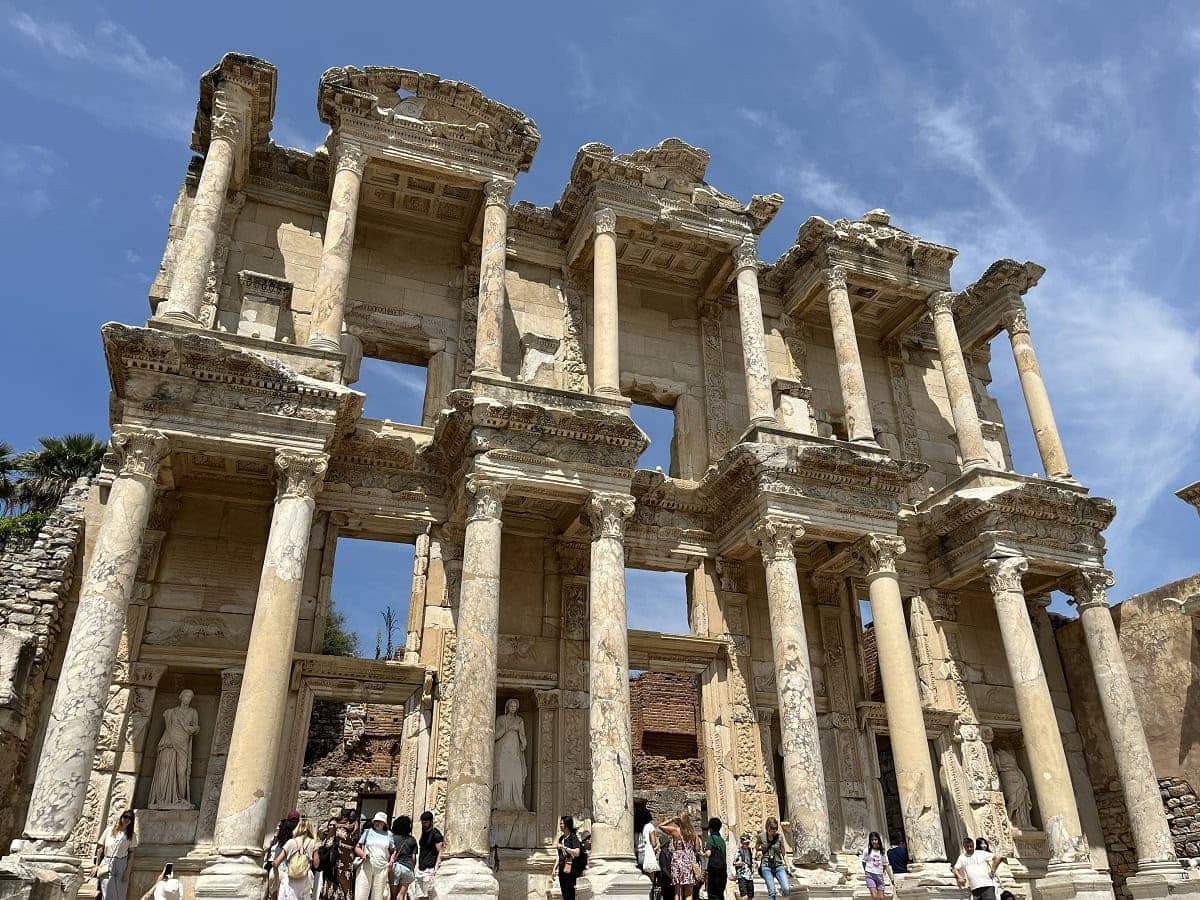
Library of Celsus – Iconic ancient library with the grand two-storey façade with sculptures; symmetrical columns and ornate pediments.

Great Theatre – Huge amphitheatre seating 20–25,000 ancient patrons.

Honestly, nothing had prepared us for the scale and grandeur of this experience. Pompeii was amazing too, but we’d studied that city from when we were school kids, and Ephesus for us was totally unknown and took us totally by surprise.

A cute little treat throughout the walk was seeing the large numbers of cats that now make the city their home – there were cats sunning themselves on monuments, sitting on marble statues watching people pass by, or just enjoying a pat from the visitors.


The Virgin Mary’s House
From the ruins of Ephesus our guide bussed us just 6km away to Meryemana (The Virgin Mary’s House), supposedly the final house where Mary spent her last days. There’s a beautiful, well maintained little stone cottage there and a tiny little church. Of obvious religious significance this is a popular attraction. I found it merely an interesting place, where’s Mrs Wanderer and several other visitors were clearly overwhelmed with emotion once inside the site – by its significance and presence.

Lunch and the Great Carpet Hustle
Then on to Lunch where we enjoyed a traditional Turkish lunch and a table that groaned with the weight of the many delicious dishes that made their way from the kitchen to us. Dips, pide, dolma, kofte, salads, meats, Turkish sweets. Yummo!
After lunch the guide invited us to see Turkish rugs made by local masters. Whilst an optional experience it ended up being like a time-share type thing where the carpet sellers locked us in a room (ok a tiny bit of exaggeration there), offered us tea, coffee, drinks, then proceeded to show us rug after rug after rug after rug to try and get us to buy.
The throng of saddam-style mustachioed salesmen used high pressure tactics and lots of different angles to try to make you think the only way you were going to get out was to spend $10,000 USD on a rug. I thought the whole thing was pretty funny actually, and it didn’t bother me – I simply thanked them and walked out when I’d had enough, but some of the other travellers seemed to struggle a bit, taking a long time to extricate themselves.
Time for one more Temple
The final stop on the way back to the port was the site of The Temple of Artemis. Just in a field on the side of the road, these are the ruins of a massive temple built Parthenon style that had 127 marble columns each about 18 metres high. Today just one column remains and a couple of base slabs. Well, it was nice to stretch the legs again anyway….
Summary
All in all we found the trip to Ephesus well worth doing. Breathtaking actually. It truly spun our minds to imagine the day-to-day lives of the people in the town from thousands of years ago. To be standing in those marble streets, surrounded by ancient houses, shops and civil monuments and imagining the generations of people who had lived and worked here was an incredible feeling. You could almost feel the people of times past going about their daily business as you walked through the city.
And we were so glad to have done the guided tour rather than attempting to go solo. The guide was excellent – knowledgeable & entertaining, and he navigated us around the archaeological site in a manner that avoided the worst crowd choke points. And whilst the archaeological site was the standout of the day, the visit to Mary’s house was interesting, the lunch was fabulous and the carpet experience super entertaining.
Highly recommended!
Mr Wanderer
September 2025